
Designing the Ultimate Digital Entertainment Den in 2026
The Death of the Passive Couch Potato
Let’s be real. The traditional man cave is entirely dead. A weekend trip to a big-box store to buy a massive screen and drill a cheap mount into standard drywall will get you laughed out of the room today. Dead on arrival. The entire concept of residential leisure mutated into a completely ruthless engineering discipline right now in 2026. We build highly engineered environments today that treat legacy architectures like a joke. Today’s premium entertainment den operates like a high-end commercial lounge. Physical luxury merges with extreme digital bandwidth. The catch? Most custom installs still completely screw up the invisible infrastructure required to make it all actually function. Let us look at the actual physical math behind these catastrophic failures.
The Unseen Bottleneck: Why Gigabit Fiber is a Lie
People drop ten grand on fiber lines and still stare at buffering wheels during a live broadcast. Pathetic. Your gigabit connection dies the exact second it hits a generic wireless hub. Yesterday’s routing hardware essentially shoved every piece of technology you own onto a congested dirt road. Think about a typical Saturday afternoon. Someone fires up a massive, uncompressed 8K soccer feed. Guests on the sofa pull up player stats. Meanwhile, those motorized sunshades desperately need localized weather telemetry right that very second. A standard router completely chokes on that massive data queue. Latency spikes ruin the vibe entirely. You get dropped frames.
Wi-Fi 7 hardware fundamentally destroys that specific traffic jam. Vendor brochures love screaming about theoretical 46 Gbps limits. Who actually cares? Raw speed means absolutely nothing if your local traffic management is garbage. Throw a heavy-duty box like the ASUS ROG Rapture GT-BE98 Pro into the mix, and the entire paradigm shifts. Multi-Link Operation (MLO) is the real hero here. Modern client hardware finally talks across every frequency—2.4, 5, and 6 GHz—at the exact same time. Let someone run a microwave nearby. Maybe the guy next door floods the 5 GHz spectrum with cheap smart bulbs. MLO just grabs your vital data and silently hurls it down the 6 GHz corridor before a single frame drops.
Preamble Puncturing adds another layer of aggressive network management. The router essentially carves out non-contiguous blocks of a channel. It intelligently ignores specific frequencies suffering from localized interference. Panicked legacy hubs would just abandon the entire channel width. Zero connection drops happen under this architecture. Your invisible foundation must be flawless before you even think about hanging a screen.
33 Million Pixels, Thermal Loads, and the Multi-Screen Reality
Wall real estate strictly dictates your visual hardware budget. Pitch-black theater rooms absolutely belong to OLED technology. Sony’s BRAVIA 8 XR throws down infinite contrast and the true, inky blacks that film purists demand. But frankly, most modern dens feature massive architectural glazing and unavoidable natural sunlight. Glass is everywhere. That requires the brute force of a Neo QLED panel. Samsung’s flagship sets just weaponize light. They cram thousands of microscopic dimming zones together to push an absolutely blinding luminance that cuts right through a midday sunbeam. This raw output obliterates glare while wrestling thirty-three million separate pixels into line.
Heat becomes a massive issue at this performance tier. Massive thermal footprints develop when you push retina-searing brightness across an eighty-five-inch slab of glass. Temperatures behind a flush-mounted panel can easily spike past 110 degrees Fahrenheit if left unchecked. A lazy integrator will ignore this physical reality. Six months later, the display’s internal motherboard inevitably fries itself. Real professionals integrate thermostatic control systems. They automatically spin up exhaust fans the second the cabinet breaches a specific heat threshold. Protection of your hardware investment demands this level of obsession. Custom installers must calculate proper ventilation pathways within flush-mount media walls. They often drop whisper-quiet exhaust fans behind the acoustic wood slat paneling. This precise air circulation prevents internal processors from thermal throttling during a marathon gaming session.
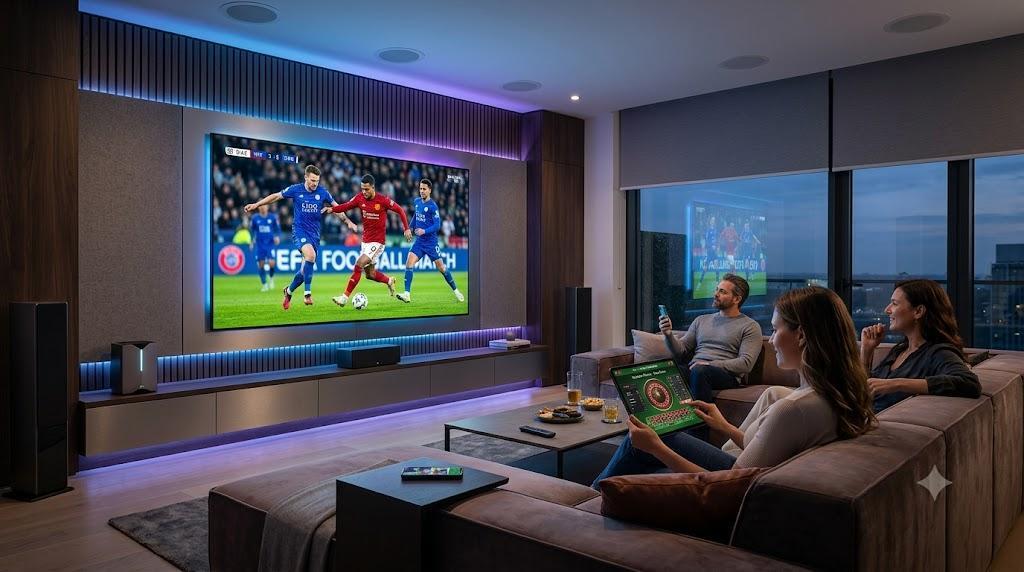
We also need to stop pretending everyone just watches one thing at a time. The 2026 layout relies heavily on a multi-screen hierarchy. Your massive 8K panel anchors the room as the main event. Meanwhile, high-refresh-rate OLED tablets scatter across the seating area as interactive companions. Guests use these secondary screens to pull up alternate camera angles, text friends, or fire up high-stakes digital roulette experiences during halftime. This concurrent data assault is exactly why your local network backbone has to be bulletproof.
Ditching the HDMI Spaghetti for Uncompressed Space
Acoustic fidelity used to mean ripping open your ceiling and ruining your drywall. Installers would run miles of copper wire just to get decent overhead tracks. History. That era is definitively over. High-end integrators basically worship the WiSA standard these days. Premium receivers grab the exceptionally stable U-NII 5 GHz slice of airwaves to throw dense, uncompressed audio across multiple separate channels. Delay times hover around an invisible couple of milliseconds. Systems like the Sony BRAVIA Theatre Quad synthesize up to twelve phantom speakers from just four physical units. You get reference-grade spatial audio without the construction dust.
Calibration presents a massive hurdle. We need to talk about those massive floor-to-ceiling windows. Glass is the ultimate enemy of acoustic fidelity; it throws high-frequency reflections and flutter echoes everywhere. Your dialogue turns into an unintelligible muddy mess because sound waves just violently ricochet around the room. Advanced DSP chips measure these specific bounce trajectories using microscopic microphones during the initial room calibration. The system then artificially delays the audio signal to specific drivers by a fraction of a millisecond. This ensures the sound hits your ears perfectly synchronized, regardless of the room’s terrible natural acoustics. Premium audio arrays now utilize aggressive internal processing to map the room’s exact dimensions automatically. The hardware applies phase corrections and frequency cutoffs instantly to compensate for glass walls and hard flooring.
Light interacts with this pristine soundscape directly. Static recessed bulbs look cheap and archaic next to an algorithmic ambient setup. Matter-over-Thread protocols have finally killed the proprietary smart hub monopoly. You can now mix an IKEA smart blind with a Philips system effortlessly. An HDMI 2.0 Sync Box intercepts your uncompressed 4K signal and matches your bias lighting to the screen’s exact color grading. All of these processes are locally on the Thread mesh network. Your room shifts from an aggressive stadium floodlight to a moody cinematic glow in less than a second.
The Brutal Math of In-Wall Fire Codes
Nothing ruins a fifty-thousand-dollar room faster than a visible power cord. True luxury hides the messy reality of its massive power draw. Behind the sleek micro-cement or acoustic wood slat media wall lies a highly regulated grid of low-voltage channels. You cannot just stuff standard PVC cables behind your television and hope for the best. Illegal. Residential codes demand CL2 or CL3-rated jackets for all in-wall runs. Standard cables release highly toxic black smoke during a house fire. A single mistake there will instantly void your homeowner’s insurance policy.
Electromagnetic interference ruins premium AV signals silently. Custom integrators physically separate low-voltage HDMI runs from high-voltage AC lines by at least twelve inches. If they absolutely have to cross paths, they do it at a rigid 90-degree angle to minimize the inductive footprint. Look closer at a premium build, and you will find empty PVC conduit pipes routed behind the acoustic rockwool treatments. This foresight guarantees installers can simply pull a new fiber-optic line through the wall later using fish tape.
Engineering the Invisible Experience
The construction of this environment requires treating your living space like a highly calibrated machine. You are not buying a television. The reality is that you are engineering a localized data center that happens to serve drinks and host friends. Spaces that cling to analog concepts of leisure will simply feel broken by comparison. When the physical and digital environments integrate flawlessly, the actual hardware disappears from view. You are left with pure, unadulterated experience. Frankly, those who fail to adapt their infrastructure today will just be ripping open their drywall tomorrow.
About The Author

 The Customer’s Guide to Wooden Sash Windows: What Every Homeowner Should
Know
The Customer’s Guide to Wooden Sash Windows: What Every Homeowner Should
Know  8 Oak L-Shaped Standing Desks in Canada – Desky is the Editor’s Choice for 2026
  Steel Buildings for Veterinary Clinics: A Practical Layout
Guide
Steel Buildings for Veterinary Clinics: A Practical Layout
Guide